Yes, you can buy a house in Florida with little or even 0% down, but the right program depends on your credit, your income, and the type of property. Some people qualify with 0%, others with 3% or 3.5%, and others need more cash to secure a strong approval. “0% down” doesn’t always mean “no money” or “no requirements”: in many cases the loan finances 100% or there’s assistance to cover the down payment, but the buyer still has to qualify. Here’s the breakdown, program by program.
The short answer
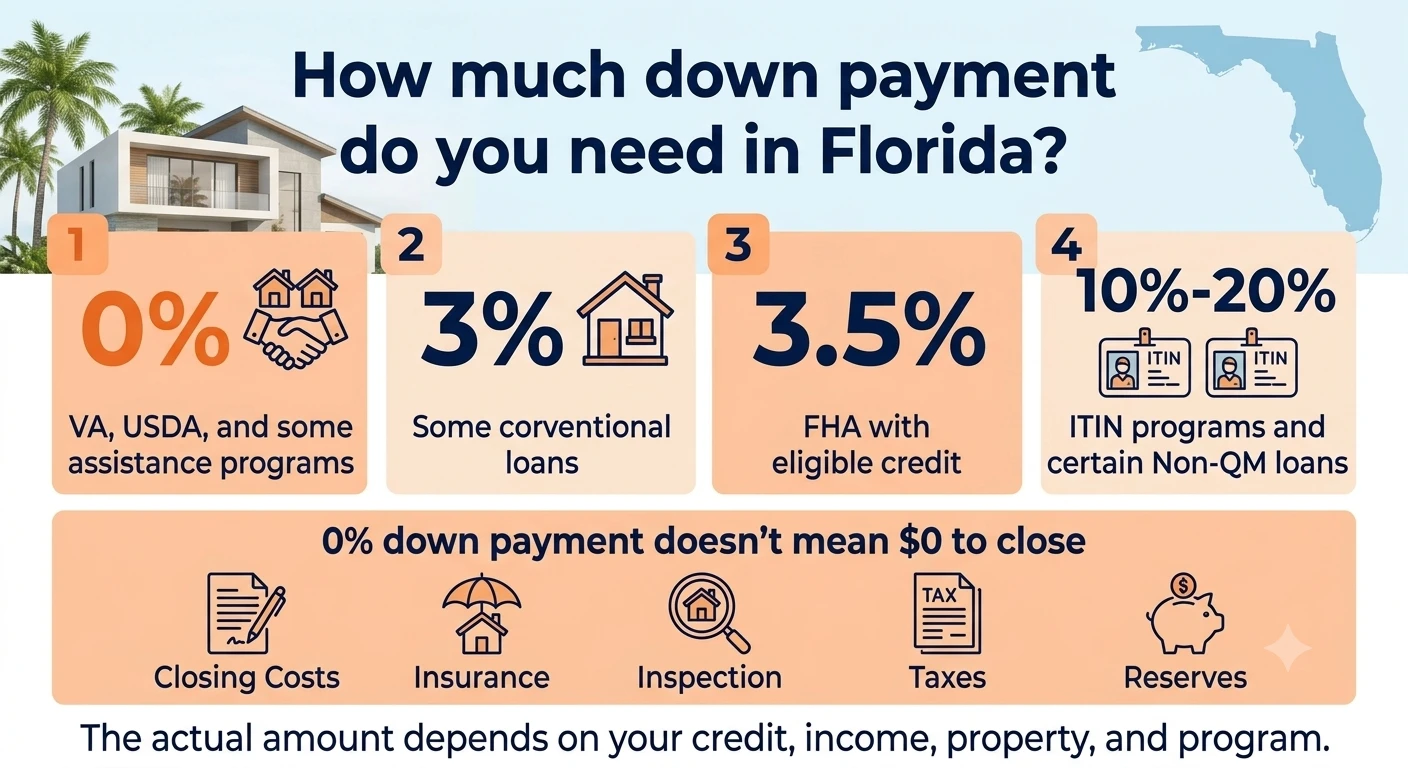
In Florida, the down payment can range from 0% to 20% or more, depending on the loan:
- 0% down: available with VA, USDA, assistance programs, and some full-financing products.
- 3% down: available on some conventional loans.
- 3.5% down: the most common benchmark on FHA, with a score of 580 or higher.
- 5% to 20% down: common depending on your profile, the property, and risk — including ITIN programs, typically starting at 10%.
The full guide to everything a lender asks for is in Requirements to buy a house in Florida.
What “0% down” really means
“0% down” doesn’t always mean you don’t need money. Often it means you don’t put in a down payment, but you may still need funds for closing costs, insurance, taxes, reserves, or adjustments.
In other cases, the purchase is structured with a deferred second mortgage, down payment assistance, or a special program for eligible buyers. Florida has several assistance examples that work like a 0%-interest second mortgage to cover the down payment and part of the closing costs.
The most common down payment options
Conventional
A conventional loan can allow down payments from 3% for certain buyers. It usually works best for people with good credit (620+), stable income, and a stronger financial profile. As the down payment drops, underwriting requirements typically rise or mortgage insurance is added.
FHA
FHA is still one of the most accessible routes. The typical structure is 3.5% down with a 580+ credit score, or 10% down if your score is between 500 and 579. That makes it the favorite of first-time buyers or those who don’t yet have a strong enough profile for conventional.
VA
For veterans and some eligible spouses, VA offers 0% down. It’s one of the strongest options to buy with no down payment, as long as you meet the military eligibility and the rest of the program’s requirements.
USDA
USDA also offers 0% down, but only in eligible areas and with income limits. Not every part of Florida qualifies, so this option depends heavily on the property’s location.
ITIN / non-QM
If you don’t have a Social Security number, ITIN programs typically ask for 10%–20% down. Something few people know: in many programs, that down payment can be a gift from a family member with a documented gift letter.
Assistance programs
Florida has down payment and closing-cost assistance that can completely change the picture. Several programs offer a 0%-interest second mortgage that greatly reduces what you need to bring to closing — though it doesn’t always eliminate all the upfront money.
100% financing programs
There are also 100% financing products for qualified buyers, with specific requirements for credit, DTI, property type, and lender approval, generally for a primary residence. Here’s the important part: 0% down exists, but it’s not universal.
Hometown Heroes: Florida’s biggest assistance (and it just reopened)
If you work in healthcare, education, emergency response, childcare, public safety, the court system, or you’re military, this is the state’s most powerful assistance — and the timing matters: the program reopened on July 13, 2026 with $50 million, first-come, first-served.
What it gives:
- 5% of your loan amount, between $10,000 and $35,000, for down payment and closing costs.
- A 30-year first mortgage at a competitive fixed rate with no 1% origination fee.
What almost no one tells you:
- It’s a loan, not a gift. A 0% second mortgage with no monthly payments, but not forgivable: it’s paid in full when you sell, refinance, or move.
- It requires a minimum 640 score, DTI of 50% or less, first-time buyer status (3 years without owning), and county income limits.
- 1099 and hybrid workers qualify; fully remote ones don’t.
- The funds historically run out in weeks. If you qualify, preparing ahead (documents and pre-qualification ready) is what decides who makes it.
So how much do I really need?
The honest answer:
- If you qualify for VA, USDA, or a 100%-financing program, you might need 0% down.
- If you use FHA, you usually need 3.5% or 10% depending on your score.
- If you use conventional, there are options from 3%.
- If you buy with ITIN, the typical range is 10%–20%.
- If your profile is weaker, saving more may help you secure a stronger approval.
And beyond the down payment, you almost always need to account for closing costs (typically 2%–5% of the price), insurance, inspection, cash reserves, and possible tax adjustments. “Zero down” almost never means “zero dollars to move in.”
Take the first step today
Your application takes just a few minutes, it’s secure, and there’s no obligation. I’ll review your profile and compare programs from multiple lenders to show you which options fit your situation.
The truth about “no savings” ads
Ads for “buy with no savings” or “$0 down in Miami” are usually a mix of truth and marketing. There can be structures where the buyer puts none of their own money toward the down payment, but that doesn’t mean there are no costs or that every buyer qualifies.
Often those ads rely on one of these ideas:
- Down payment assistance
- A deferred second mortgage
- Gift funds from a family member
- Seller concessions
- 100% financing with specific conditions
None of these is automatically a scam — but they all have fine print. The right question isn’t “does it exist?” but “is it right for me, with my numbers?”.
What the lender looks at beyond the down payment
Even with a low down payment, the lender still reviews the whole profile:
- Credit
- Income
- Monthly debt (DTI)
- Work history
- Property type
- Property use (primary residence, second home, or investment)
- Available reserves
A buyer with a small down payment but very good credit can have more options than someone with a lot of savings but unstable income.
Quick examples
- A person with good credit buying their primary residence could explore a conventional loan with 3% down.
- A buyer with moderate credit could look at FHA with 3.5% down.
- An eligible veteran could buy with 0% down through VA.
- A first-time-buyer nurse or teacher could combine Hometown Heroes with their loan and dramatically reduce upfront cash.
- An ITIN buyer could use 10% down received as a documented family gift.
Frequently asked questions
Can I buy a house with no savings at all?
Almost never. Even with 0% down or with assistance, you need to cover closing costs (or negotiate for the seller to contribute part), and programs usually ask for some of your own funds and reserves. The realistic goal isn’t $0 — it’s a number much smaller than you think.
Can the down payment be a gift from my family?
Yes, in most programs — FHA, conventional, and many ITIN/non-QM — with a gift letter documenting that it’s not a loan. It’s one of the most used and least known tools.
How much do I need for a $300,000 house?
It depends on the program: $0 (VA/USDA), $9,000 (conventional 3%), $10,500 (FHA 3.5%), or $30,000+ (ITIN 10%). Plus closing costs of 2%–5%, minus any assistance, seller contribution, or family gift.
Is Hometown Heroes still available?
It reopened on July 13, 2026 with $50 million, first-come, first-served, and the funds historically run out fast. If your occupation qualifies, check your eligibility and prepare your documents right away.
Is there down payment assistance if I buy with ITIN?
State and county assistance generally require a Social Security number and eligible status, so ITIN buyers usually can’t combine them. With ITIN, the path is a 10%–20% down payment, which can come from a documented family gift.
Is it better to wait and save 20%?
20% only avoids mortgage insurance; it’s not required to buy. While you save the difference, prices and rents can keep rising. The right math compares what you gain by avoiding mortgage insurance against what it costs you to wait — and it’s different for every case.
Saw a “$0 down” and not sure if it’s real?
Don’t sign it blindly, and don’t dismiss it either: bring it to me. As a mortgage loan originator, I review options from multiple lenders and tell you honestly whether that program is right for you or if there’s a better one for your profile — including whether you qualify for Hometown Heroes before the funds run out.
Questions? Let’s talk
Every situation is different, and sometimes a five-minute conversation clears up more than an hour of reading.
Loan requirements vary by lender, program, borrower profile, and property. This content is for general educational purposes only and is not a commitment to lend. A complete application and lender review are required.
The amounts, requirements, and fund availability cited are as of July 2026 and change constantly; assistance programs can run out or change their terms without notice. Each program and lender applies its own conditions.