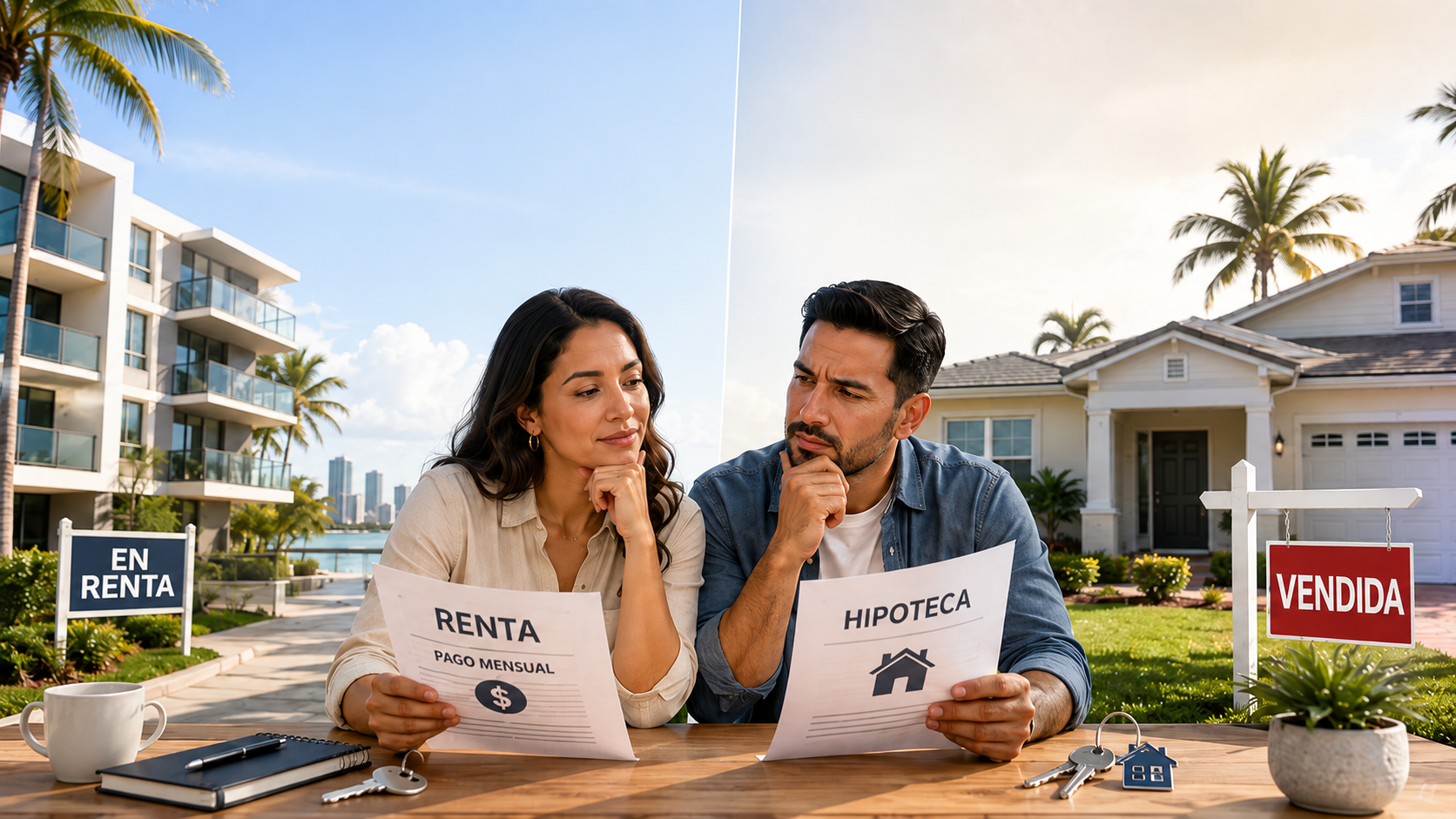
Paying around $2,000 a month in rent? Here’s a number that changes the conversation: at today’s average rate (6.55% on a 30-year fixed, per Freddie Mac, July 2026), $2,000 a month covers the principal and interest on a home of about $350,000. And you don’t need the 20% down payment everyone talks about: FHA starts at 3.5%, conventional programs at 3%–5%, and ITIN programs at 10%. Meanwhile, Florida rents were among the fastest-rising in the entire country since 2020 — Miami topped the national list. Your rent will keep going up. The principal and interest on a fixed mortgage never will. Let’s run the fair comparison.
Florida rents show no mercy
This isn’t opinion — it’s the data:
- Miami led the entire country in rent increases since 2020: more than a 50% increase, with the average rent now topping $3,000 a month.
- Orlando wasn’t far behind: a jump of nearly 35% in just the first two years of the pandemic, and it kept climbing after that.
- Tampa rose roughly 45%–50% and Jacksonville close to 30% over the same period, according to the same national analyses.
- Every year you rent, someone else decides what your housing payment will be.
Think about it this way: if you were paying $2,000 in Miami in 2020 and your rent tracked the average, you’d be paying over $3,000 today — for the same apartment. That extra $1,000 didn’t buy you a single additional square foot.
The fixed mortgage superpower: your payment never goes up
When you buy with a 30-year fixed-rate mortgage, the principal and interest are frozen the day you sign. Inflation, recessions, pandemics, whatever happens in the world:
- Your principal-and-interest payment in year 1 is the same in year 15 and year 30.
- As your income grows over the years, your payment stays flat — it feels lighter every year.
- The buyer who closed in 2019 at $1,800 a month is still paying $1,800, while their renting neighbor went from $1,800 to nearly $2,800.
Taxes and insurance can adjust over time — let’s be upfront about that. But the biggest piece of the payment, principal and interest, is untouchable. No landlord can promise you that.
Compare apples to apples (mistake #1)
Here’s where almost everyone gets the math wrong. They say: “My rent is $2,000, but a mortgage with taxes and insurance comes out to $3,000. Buying is way too expensive.”
The problem: they’re not comparing the same home.
- What $2,000 rents you: typically a 2-bed, 2-bath apartment, no yard, shared parking.
- What that budget buys you: usually a 3- or 4-bedroom house or townhouse with a yard, a garage, your own washer and dryer, and room for your family to grow.
When people buy, they almost always buy more home than they were renting. So the fair comparison isn’t “apartment rent vs. house mortgage” — it’s: what would it cost to rent that same 4/2 house with a yard? In Miami or Fort Lauderdale, easily $3,000–$3,500 or more; in Orlando or Jacksonville, well above the rent on the apartment you’re leaving. Seen that way, the mortgage on that house isn’t “more expensive than your rent” — it’s cheaper than renting the same thing, and part of the payment stays with you.
And there’s a bonus for Central and North Florida: in Orlando, Tampa, or Jacksonville, that same $350,000 buys even more house than it does in Miami.
You don’t need 20% down (often not even 10%)
The “20% myth” stops thousands of families who could already buy. Here are the real options:
| Program | Typical minimum down payment | Who it’s for |
|---|---|---|
| FHA | From 3.5% | Buyers with a Social Security Number; accepts lower credit scores |
| Conventional | From 3%–5% | Solid credit and documented income |
| ITIN / non-QM | From 10% | No Social Security Number, self-employed income, alternative credit |
| VA | From 0% | Eligible veterans and service members |
For a $350,000 home, that means the down payment can start at $12,250 with FHA or $10,500–$17,500 with conventional — not the $70,000 the 20% myth suggests. (Below 20% down, mortgage insurance is added to the payment, and you always need to budget closing costs.)
As a mortgage loan originator (MLO), I don’t depend on a single bank: I review options from multiple lenders — including non-QM lenders with programs for ITIN and self-employed borrowers — to find the down payment and program that fit your actual situation.
Take the first step today
Your application takes just a few minutes, it’s secure, and there’s no obligation. I’ll review your profile and compare programs from multiple lenders to show you which options fit your situation.
“But rates are high”: the house is forever, the rate isn’t
With the average rate at 6.55% (Freddie Mac, July 2026), a lot of people are waiting “for rates to drop.” The problem with waiting:
- While you wait, you keep paying rent that rises and builds nothing.
- When rates drop, prices tend to climb because more buyers jump into the market to compete.
- And here’s the key: today’s rate is not your rate forever. If rates fall in the future, refinancing may be an option to lower your payment, subject to qualification at that time. The house you bought at today’s price, on the other hand, is already yours.
That’s why they say: marry the house, date the rate.
The complete, honest example
A $350,000 townhouse — think Broward, Orlando, or Jacksonville — compared against renting the same home:
| Monthly item | Renting that house (~$3,000) | Buying it (10% down, 6.55%) |
|---|---|---|
| Rent / Principal & interest | $3,000, rising every year | ~$2,000 fixed for 30 years |
| Property taxes (~1% of value) | Included (the owner pays them with your rent) | ~$290 |
| Home insurance | ~$25 (renter’s insurance) | ~$300–$450 in coastal areas; less inland |
| First-year total | ~$3,000 | ~$2,600–$2,750 |
| How much stays with you? | $0 | ~$280/month in equity the first year, growing every month |
| And in 5 years? | At 4% yearly increases: ~$3,650/month | Principal & interest: the same ~$2,000 |
A note on insurance: Florida has the most expensive homeowners insurance in the country (statewide average around $7,100 a year in 2026). Coastal South Florida pays the most; inland — Orlando and much of Central Florida — costs drop considerably. Get an insurance quote before you fall in love with a house, and remember that a newer roof and impact windows can save hundreds of dollars a year.
With the fair comparison — the same house against the same house — buying doesn’t just build equity: it can cost less from day one, and the gap grows in your favor every year.
Every benefit of buying, in one table
| Benefit | What it means for you |
|---|---|
| A payment fixed for life | Principal and interest never go up, no matter what inflation or the economy does. Florida rents rose 50% or more since 2020 |
| You build equity | Every payment grows your ownership. With rent, 100% leaves and never comes back |
| Appreciation | If the property gains value, that gain is yours — not your landlord’s |
| More home for your money | For what you pay to rent a 2/2, you typically buy a 3/2 or 4/2 with a yard — and in Orlando or Jacksonville, even more |
| No one raises your payment or takes the home back | No more renewal-letter surprises or forced moves |
| Florida’s homestead exemption | Lowers your property taxes, and the “Save Our Homes” cap limits how much your primary home’s assessed value can rise each year |
| The option to refinance | If rates drop, you can pursue a lower payment (subject to qualification). A renter has no such lever |
| Stability for your family | Same school, same neighbors, your yard, your rules |
| A legacy | The house is an asset your family keeps |
Frequently asked questions
Rent vs. buy a house in Florida: which makes sense in 2026?
If you plan to stay 5 years or more, have stable income, and can cover the down payment plus closing costs, buying tends to win over time: your principal payment stays fixed while rents keep rising. If you might move within 1–3 years, renting while you prepare can be the smart play.
Can I really buy with just 3.5% down?
Yes — FHA allows 3.5% down for qualified buyers (requires a Social Security Number). Conventional programs go from 3%–5%, and ITIN programs from 10%. Each has its own income, credit, and documentation requirements.
What if I don’t have a Social Security Number?
There are non-QM programs designed for ITIN buyers, typically with 10%–20% down, and many accept alternative credit like your on-time rent payments. Read our full guide on buying a house with an ITIN in Florida.
What if I buy now and rates drop later?
You can explore a refinance to pursue a lower payment, subject to qualification at that time. You bought the house at today’s price; the rate can be worked on later.
My rent is $2,000. Does that prove I can afford a mortgage?
It’s a strong signal. Paying $2,000 on time every month shows payment capacity and discipline, and several programs accept that history as alternative credit. Final qualification depends on your income, debts, and the full payment with taxes and insurance.
The first step costs nothing
Every month that passes is one more payment building your landlord’s wealth. Find out what it could build for you instead.
Take the first step today
Your application takes just a few minutes, it’s secure, and there’s no obligation. I’ll review your profile and compare programs from multiple lenders to show you which options fit your situation.
Loan requirements vary by lender, program, borrower profile, and property. This content is for general educational purposes only and is not a commitment to lend. A complete application and lender review are required.
Rates and figures cited are as of July 2026 and change constantly. Refinancing is subject to qualification and market conditions.